Innovative Features at Tucan Casino: Enhancing Mobile Gaming
La résonance culturelle des symboles dans le jeu vidéo et les machines à sous
a. La résonance culturelle des symboles dans le jeu vidéo et les machines à sous repose sur une transmission profonde des anciennes croyances. En France comme ailleurs, les symboles agissent comme des ponts entre passé et présent, éveillant des associations inconscientes liées à la fertilité, la prospérité ou la divinité. Les machines à sous, bien que modernes, exploitent ces archétypes pour captiver : la machine à sous « Sweet Bonanza Super Scatter » en est une illustration éclatante. Ce lien entre symboles millénaires et jeu interactif nourrit une expérience émotionnelle forte, où chaque symbole déclenche non seulement un gain, mais aussi une mémoire culturelle.
b. Pourquoi les motifs anciens continuent-ils de captiver les joueurs francophones ? La réponse réside dans leur universalité. La banane, par exemple, incarne la fertilité depuis l’Antiquité, un symbole qui traverse les civilisations. En France, elle a évolué d’emblème exotique — popularisée par les expositions universelles comme celle de Philadelphie en 1876 — vers un emblème intime du quotidien. Les jeux modernes en tirent parti, intégrant ces images avec un pouvoir symbolique largement compris, même sans conscience explicite.
c. La banane, fruit lié à la fertilité depuis l’Antiquité, est aujourd’hui une icône moderne dans les jeux français. Sa présence visuelle, souvent associée à la richesse et à la chance, renforce l’expérience ludique en jouant sur des attentes culturelles profondément ancrées. Comme le souligne un chercheur en études culturelles, « le fruit tropical devient un symbole de récompense universelle, familier au-delà des frontières linguistiques ».
Bananes, symboles de fertilité : racines historiques et empreinte dans la culture française
a. La banane est devenue un symbole reconnu en Occident au XIXe siècle, notamment lors des expositions universelles. Si elle était déjà présente dans la mythologie comme fruit de paradis (le « fruit défendu » revisité), c’est surtout à partir de 1876, lors de l’exposition de Philadelphie, que son image s’est démocratisée. Elle y était présentée comme un trésor exotique, symbole de prospérité coloniale et de modernité.
b. En France, cet apport s’est traduit par une appropriation progressive : la banane n’est pas seulement un fruit, mais un signe de bienveillance et de générosité. Elle figure dans les publicités, puis dans les jeux vidéo et les machines à sous comme symbole de victoire rapide et abondante. Ce passage du symbolisme religieux ou colonial à un usage ludique reflète une adaptation subtile aux codes contemporains.
c. Dans les jeux français contemporains, la banane apparaît souvent dans les motifs visuels ou comme multiplicateur, rappelant que la chance peut surgir du fruit le plus humble. Par exemple, dans « Sweet Bonanza Super Scatter », elle sert non seulement de motif esthétique, mais aussi de signe de multiplicateur, établissant un parallèle direct entre tradition et jeu.
Grappe de raisin : symbole antique de prospérité dans la pensée grecque et son reflet contemporain
a. Dans l’Antiquité grecque, la grappe de raisin incarnait l’abondance divine, liée à Dionysos, dieu du vin et de l’abondance. Elle symbolisait la fécondité de la terre, la joie des récoltes, et était un motif récurrent dans l’art et la littérature, représentant la récompense ultime du travail et de la nature.
b. En France, cette symbolique de l’abondance résonne profondément, notamment dans les jeux de hasard où la réussite est associée à la richesse et au partage. Le raisin, et par extension la grappe, devient un archétype naturel de gain, renforçant l’attrait des jeux par leur évocation de prospérité collective.
c. Dans les machines à sous françaises, la grappe de raisin ou ses dérivés visuels sont souvent intégrés comme multiplicateurs ou symboles de victoire. Leur présence ancre le jeu dans une tradition symbolique ancienne, où chaque combinaison rappelle la fécondité de la terre, et chaque jackpot, une bénédiction antique revisitée.
« Sweet Bonanza Super Scatter » : un lien moderne avec des symboles ancestraux
a. Ce mécanisme de multiplicateurs allant jusqu’à 100x évoque immédiatement l’idée de richesse inépuisable, un écho direct aux mythes de l’abondance. Le joueur ne gagne pas seulement : il participe à un rituel moderne où la chance se transforme en abondance, comme si chaque symbole déclenchait une bénédiction millénaire.
b) Le concept de « super scatter » s’appuie inconsciemment sur ces archétypes universels : le fruit qui tombe du ciel, la générosité des dieux, la promesse d’une récompense infinie. Cette résonance émotionnelle est stratégique : elle transforme un simple effet de jeu en expérience symbolique. Comme le note un anthropologue culturel, « chaque multiplicateur est une écho moderne d’un mythe ancien, où chaque grain de raisin ou chaque banane récompense la foi en la prospérité ».
c) La banane, fruit lié à la fertilité, apparaît parfois dans ses motifs visuels comme un clin d’œil culturel subtil. Elle rappelle à la fois l’exotisme des contrées lointaines et l’accessibilité du jeu, où même le fruit le plus humble peut déclencher la fortune.
Les joueurs français face aux symboles anciens : entre fascination et jeu interactif
a. Les symboles anciens suscitent chez les joueurs français une fascination mêlée d’émotion : ils évoquent des racines historiques, une richesse culturelle souvent méconnue mais puissante. La « Sweet Bonanza Super Scatter » en est une manifestation tangible, où tradition et modernité s’unissent dans une expérience ludique.
b) Les concepteurs français tirent parti de ce pont culturel en intégrant des symboles comme la banane ou la grappe avec authenticité, non pas comme simple décoration, mais comme vecteurs de sens. Ces références renforcent l’identité du jeu, le distinguant par une profondeur qui dépasse le simple divertissement.
c) Parmi les exemples locaux, certains jeux indépendants français revisitent ces symboles avec créativité et respect. Par exemple, des projets utilisant la banane comme symbole de chance dans des machines à sous narratives offrent une expérience à la fois ludique et culturelle, révélant un patrimoine symbolique vivant.
Vers une approche pédagogique : comprendre les jeux modernes pour mieux saisir leur héritage symbolique
a. Explorer les racines historiques des symboles dans les contenus numériques est essentiel pour comprendre leur force émotionnelle. « Sweet Bonanza Super Scatter » n’est pas qu’une fonctionnalité : c’est une passerelle culturelle accessible, où le joueur reconnaît inconsciemment des archétypes universels.
b) Le lien avec « Sweet Bonanza Super Scatter » illustre comment un simple effet visuel peut incarner des siècles de symbolisme. En France, cette richesse est souvent passive ; mais ici, elle est active, éducative, et ludique.
c) Cette approche enrichit notre compréhension du patrimoine symbolique vivant. Loin d’être obsolète, la tradition symbolique se réinvente dans le jeu moderne, offrant à chaque joueur une expérience à la fois familière et nouvelle, fondée sur des héritages millénaires.
La résonance culturelle des symboles dans le jeu vidéo et les machines à sous
a. Depuis les expositions universelles du XIXe siècle, les symboles anciens parcourent les écrans modernes. La banane, popularisée à Philadelphie en 1876, est devenue bien plus qu’un fruit : elle incarne la fertilité, l’exotisme, et la promesse de richesse. Ce symbole traverse les cultures pour toucher l’inconscient collectif, un pont entre passé et present.
b. En France, cette résonance se nourrit d’une histoire riche : le jeu moderne capture subtilement ces archétypes. « Sweet Bonanza Super Scatter » en est un exemple parfait, où la banane n’est pas qu’un motif, mais un signe de multiplicateurs, évoquant une générosité divine revisitée.
c.
Dans les vastes étendues de l’Ouest américain, le cowboy incarne bien plus qu’un simple héros du far west : il est un symbole vivant de la rencontre entre l’homme et le risque, un témoin silencieux d’un monde gouverné par des lois mathématiques souvent invisibles. Son quotidien, entre survie et adaptation, reflète des mécanismes probabilistes fondamentaux — comme le calcul inconscient du risque face à la poussière, au vent et aux caprices du désert. C’est précisément cette tension entre hasard apparent et structure cachée que la science des multiplicateurs permet de rendre intelligible, transformant chaque choix, chaque événement, en une pièce d’un puzzle où la probabilité globale façonne la vie même du cowboy.
Des bâtiments en adobe aux pépites d’or : accumulation de hasard à travers les siècles
Les constructions en adobe, durables jusqu’à deux siècles, rappellent la stabilité face à un environnement hostile — une métaphore puissante de la convergence des probabilités sur le long terme. À l’inverse, les pépites d’or découvertes lors de la ruée vers l’or californienne, atteignant parfois plus de 24,5 kg, illustrent des gains extrêmes nés d’événements rares mais réels. Ces exemples tangibles montrent que le hasard, loin d’être du simple hasard, s’accumule comme une force amplifiée : chaque goutte d’eau trouvée, chaque tempête survivue, chaque pépite extraite ajoute une probabilité supplémentaire, dont l’effet s’additionne jusqu’à transformer un destin humble en succès extraordinaire.
- Adobe : stabilité face à l’adversité, comme un processus probabiliste convergent
- Or de Californie : gains extrêmes issus de faibles probabilités, multipliés par le temps et les événements rares
Ce phénomène révèle une vérité profonde : dans un environnement imprévisible, la survie et la réussite s’expliquent par la somme des petites chances, un peu comme un multiplicateur amplifie un faible signal en une certitude tangible. Ce lien entre le quotidien du cowboy et les mathématiques modernes ouvre une fenêtre sur la manière dont le hasard, bien ordonné, structure même les vies les plus libres.
Les cactus saguaro : un cycle de vie millénaire comme modèle de résilience probabiliste
Le cactus saguaro, capable de vivre plus de deux siècles et atteignant jusqu’à 12 mètres, incarne une patience exceptionnelle : son cycle de croissance est le fruit de milliers d’événements aléatoires — pluies imprévisibles, tempêtes, germination — qui, combinés, forment une trajectoire de résilience. Chaque germinatif, chaque année de croissance, représente un pas dans une chaîne probabiliste où la survie dépend de la force ajoutée par des chances minimes mais réalistes.
Cette dynamique rappelle la manière dont les récits de l’Ouest américain — le cowboy, les chemins, les tempêtes — tissent une vision du temps et du risque profondément ancrée dans le hasard structuré. En France, ce regard sur la nature impitoyable du désert invite à reconnaître que l’ordre peut émerger du désordre apparent, tout comme les multiplicateurs transforment des probabilités individuelles en certitudes collectives.
Du cowboy au multiplicateur : la science des probabilités en action
Le cowboy n’est pas un mythe isolé, mais une figure incarnant la logique du hasard cumulé. Chaque décision — tirer, surveiller l’eau, réparer sa tente — s’inscrit dans une chaîne probabiliste où chaque choix, aussi petit, contribue à la probabilité globale de survie et de succès. Ce mécanisme rappelle celui des multiplicateurs en mathématiques, où une probabilité initiale, multipliée par une série d’événements, génère une certitude exponentielle sur le long terme.
En France, où la culture valorise à la fois l’histoire et la réflexion, ces exemples du far west offrent un pont culturel puissant vers des notions abstraites. Plutôt que des formules froides, le cowboy montre comment le hasard, modélisé par des chaînes de multiplicateurs, façonne des destins réels — une leçon d’ordre dans le désordre du quotidien.
Pourquoi le cowboy, un pont culturel vers les mathématiques modernes ?
L’Ouest américain, avec son archétype du cowboy, incarne en France une frontière symbolique — entre risque et certitude, hasard et structure — un terrain fertile pour explorer des concepts scientifiques non seulement accessibles, mais vivants. Les récits du cowboy, familiers dans la culture anglo-saxonne, deviennent des outils pédagogiques puissants pour vulgariser la science des multiplicateurs, sans abstractions arides ni formules difficiles.
Ce pont culturel invite les lecteurs francophones à redécouvrir que la science du hasard n’est pas seulement dans les manuels, mais dans les histoires qui ont façonné des sociétés. En France, ce lien entre vie rustique, écologie, et mathématiques offre une perspective nouvelle, où le cowboy devient bien plus qu’un héros : il est un enseignant silencieux des lois profondes qui régissent le hasard.
Tableau comparatif : événements alébres vs résultats cumulés
| Événement aléatoire | Probabilité initiale | Évolution sur 10 ans | Conséquence probable | |
|---|---|---|---|---|
| Pépites d’or | 1 chance sur 10 000 | Multiplication par 500 sur 5 événements | Vitesse de survie accrue | Gain extrême, transformation de destin |
| Tempêtes | 1 chance sur 100 par an | Effet cumulé sur 10 ans sur infrastructure | Renforcement des refuges | Stabilité face au risque |
| Germination du cactus | 1 chance sur 10 par an | Convergence progressive sur 30 ans | Base d’une vie longue et résiliente | Survie durable dans le désert |
« Dans le désert, chaque goutte, chaque tempête, chaque germination est une étape dans un calcul silencieux de survie : la science du hasard s’écrit dans la patience du cactus, dans la chance du cowboy, dans la certitude du temps qui convergent.
Cette articulation entre vie pratique et mathématiques révèle une vérité essentielle : le hasard n’est pas chaos, mais une structure profonde, amplifiée par l’accumulation. Le cowboy, héritier d’une sagesse du risque, illustre que chaque choix, aussi petit, peut changer le cours des probabilités. En France, ce pont culturel offre une clé pour comprendre que la science du hasard est vivante, incarnée dans les récits, les paysages, et les décisions quotidiennes.
Veddas are an indigenous people of Sri Lanka. They, amongst other self-identified native communities such as Coast Veddas and Anuradhapura Veddas, are accorded indigenous status. Most speak Sinhala and Tamil instead due to their indigenous language having become nearly extinct.
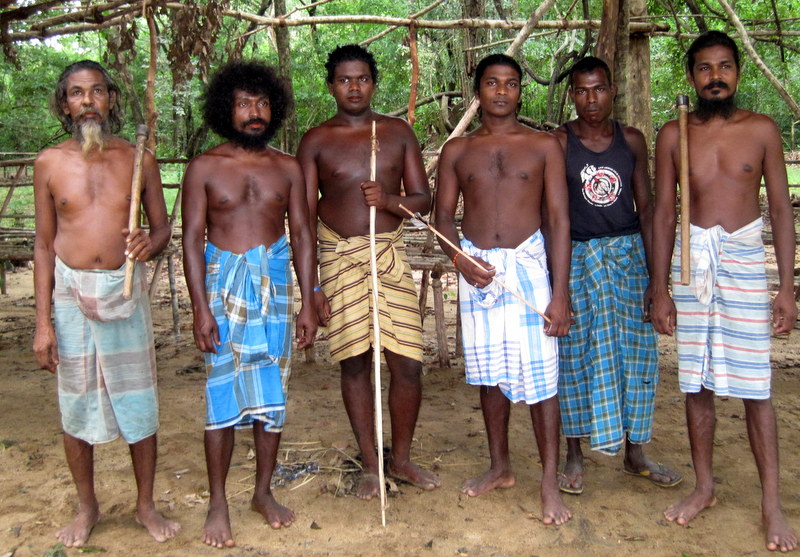
According to the genesis chronicle of the Sinhala people, the Mahavamsa (“Great Chronicle“), written in the 5th century CE, the Pulindas believed to refer to Veddas are descended from Prince Vijaya (6th–5th century BCE), the founding father of the nation, through Kuveni, a Princes of the yaksha tribe, he married.
The Mahavansa relates that following the repudiation of Kuveni by Vijaya, in favour of a Kshatriya-caste princess from Pandya, their two children, a boy and a girl, departed to the region of Sumanakuta (Adam’s Peak in the Ratnapura District), where they multiplied, and giving rise to the Vedda people. Anthropologists such as the Seligmanns (The Veddas 1911) believed the Veddas to be identical with the Yaksha.
They never cut their hair but tye it up on their Crowns in a bunch. The cloth they use, is not broad nor large, scarcely enough to cover their Buttocks. Thewilder and tamer sort of them do both observe a Religion. They have a God peculiar to themselves. The tamer do build Temples, the wild only bring their sacrifice under Trees, and while it is offering, dance round it both men and women.
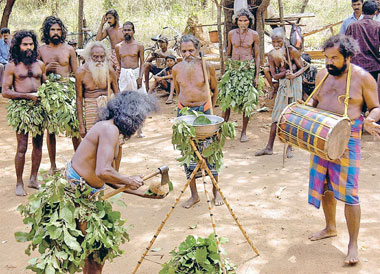
Vedda people are also mentioned in Robert Knox’s history of his captivity by the King of Kandy in the 17th century. Knox described them as “wild men”, but also said there was a “tamer sort”, and that the latter sometimes served in the king’s army.
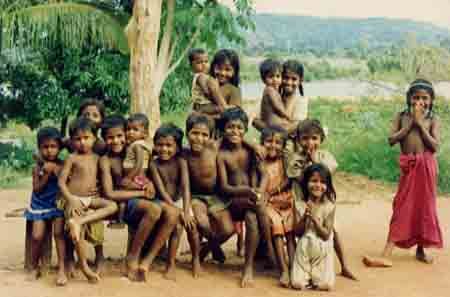
The Ratnapura District, which is part of the Sabaragamuwa Province, is known to have been inhabited by the Veddas in the distant past. This has been shown by scholars like Nandadeva Wijesekera (Veddhas in transition 1964). The very name Sabaragamuwa is believed to have meant the village of the Sabaras or “forest barbarians”. Such place-names as Vedda-gala (Vedda Rock), Vedda-ela (Vedda Canal) and Vedi-kanda (Vedda Mountain) in the Ratnapura District also bear testimony to this. As Wijesekera observes, a strong Vedda element is discernible in the population of Vedda-gala and its environs.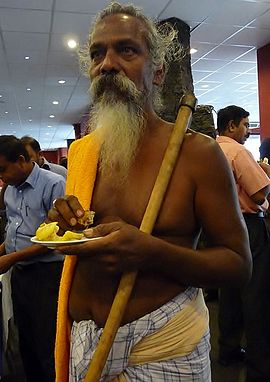
Travel Tips – Traveling Sri Lanka
Sri Lanka is one of the leading romantic destinations in the whole world. Discover the beauty of Sri Lanka and Tips for the Traveling Sri Lanka. Tour Plan lanka is the best tour Company in Sri Lanka. Also it is a land of ancient ruins and religious relics, palm-fringed beaches and colourful reefs, balmy rainforests and local legends. Life in Sri Lanka is dictated by the sea around the Island.
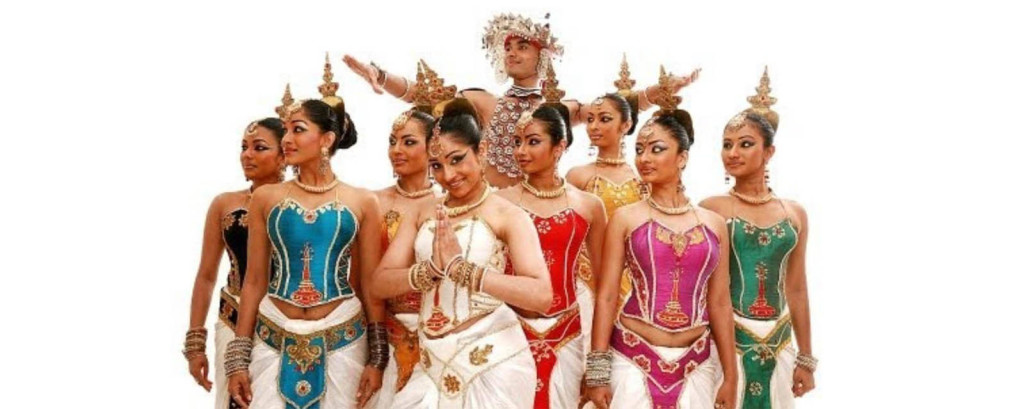
Conduct
Cleanliness and modesty are appreciated even in informal situations. Nudity and topless bathing are prohibited and subject to heavy fines. Display of intimacy is not considered suitable in public and will probably draw unwanted attention. Women in rural areas do not normally shake hands with men as this form of contact is not traditionally acceptable between acquaintance.
Hands & Eating
Use your right hand for giving, eating or shaking hands as the the left hand is considered to be unclean.Do not shake hands with a Buddhist monk or a Hindu Swami. Greet them with your hands Clasped together as if a prayer and raising them to your foreheads bending slightly forward. When handing objects to another person, using right hand or both hands would be appreciated by the receiver.
Visiting Places of Worship
Visitors to Buddhist and Hindu temples are welcome Though the shrines of Hindu temples are sometime closed to non Hindus. However, visitors to any place of Worship in Sri Lanka are expected to be decently. Clad covered down at least below knees, unshod and heads uncovered.
Read more on Travel Tips
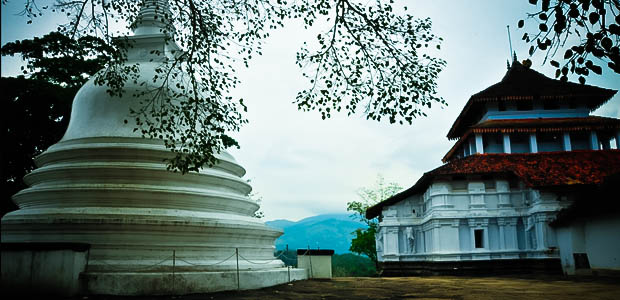
LANKA THILAKA RAJA MAHA VIHARAYA. KANDY SRI LANKA
The history of the temple goes back to the 14th century. According to historical reports this temple was built by King Bhuvanekabahu IV, who reigned from 1341 to 1351 A. D. He entrusted the construction of this temple to his Chief Minister named Senalankadhikara, who successfully finished the works of this temple. The architecture of the temple was designed by a South Indian architect named Sathapati Rayar, According to the Professor Senarath Paranavithana, Sathapati Rayar designed this temple using Sinhalese architecture of Polonnaruwa era and also with other Dravidian and Indo Chinese architectural patterns.
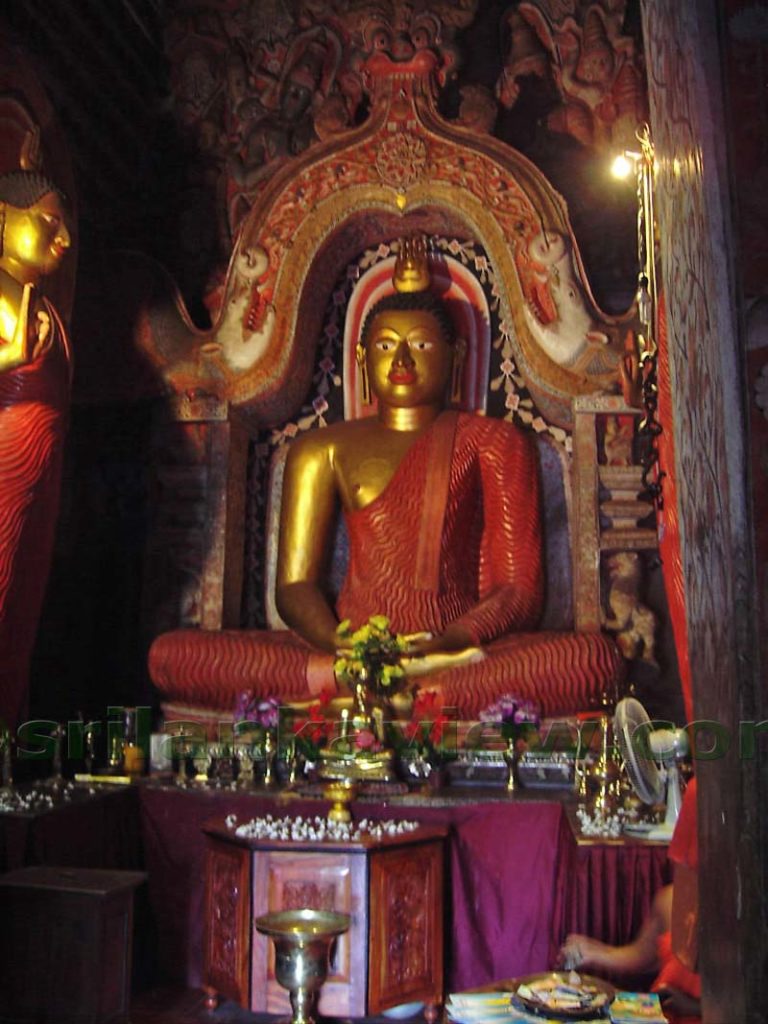
The vihara buildings have been built on a natural rock called Panhalgala Rock. Among the buildings the image house possesses characteristically outstanding architectural features, embellished with traditional Sinhalese sculptures. According the facts recorded in the Lankatilake copper plaque, this image house was construct as a four storied mansion with height of eighty feet, but today only 3 stories can be seen.The walls and the ceiling of the image house has been adorned with the Kandyan era paintings and sculptures.
Rock curved inscriptions found in the temple premises with both Sinhala and Tamil sections, proclaim about the initiators and the facilities gifted to this temple by the kings.
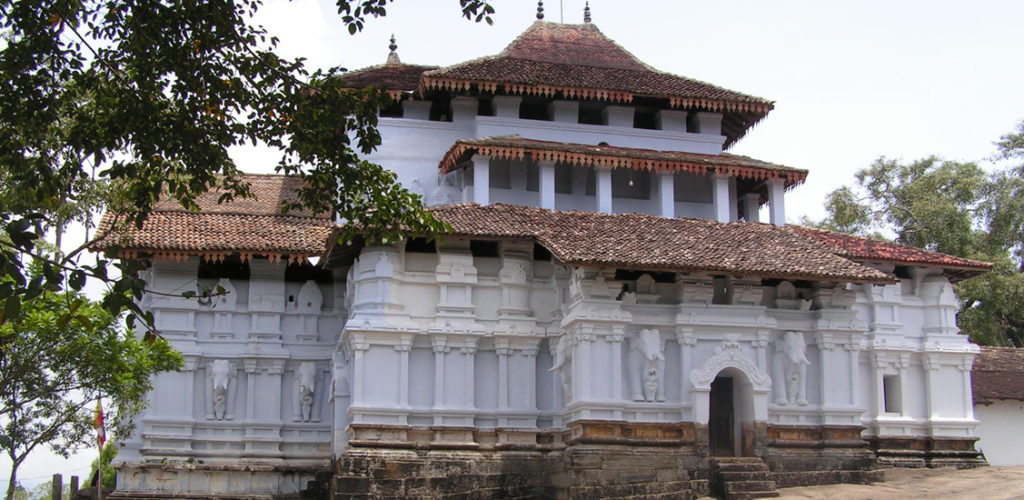
The image house of the Lankatilaka is enriched with five devales. God Upulvan, Ganapathi, Saman, Vibhishana and Kumara Bandara are worshipped here. God Kumara bandara is believed to be the deity, who protects the Lankatilaka vihara.
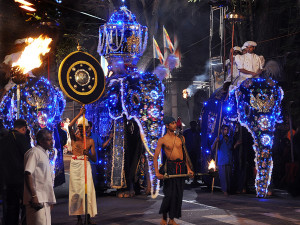
There are special religious programs conducted in the Dalada Maligawa in Kandy on every Full Moon Poya day where large numbers participate. Apart from these daily, weekly and monthly ceremonies, there are four major ceremonies held every year. They are;
- Aluth Sahal Mangailaya;
- Avurudu Mangallaya;
- Esala Mangallaya; and
- Karthika Mangallaya.
Of these the most important is the Esala Mangallaya. Esala, according to the Sinhalese Calendar, is the month of July/ August This is the months in which Kandy gets into a festive mood. Shopkeepers and hoteliers pile up their stock to cater to the massive crowds that throng the city. Maligawa and its premises are gaily decorated and are illuminated with strings of lights, including the esplanade.
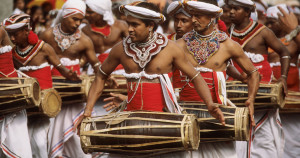
Perahera, A Kapa, a sapling from a tree that sheds milky juice is erected in each of the four Devales. On the 5th day, The Kumbal Perahera begins and goes on for 10 consecutive nights when the sacred relic casket is taken round the streets of Kandy accompanied by exotically costumed dancers and drummers.
These dance forms vary. The most popular dance froms are the Ves, Udekki, Pantheru, Naiyandi, Hewisi, Savang and Leekeli and the dancers with years of experience reveal their dexterity in the performance of their respective dances.
The most colorful Perahera is last Randoli Perahera which falls on the Esala Full Moon Poya day. On this day, at the auspicious time the Perahera starts. The Diyawadana Nilame in full traditional Kandyan dress will enter the inner chamber to receive the Perahera Karanduwa containing the Buddha Relics.
The Mahanayake Thero will place the relics casket on the velvet cloth clonintricately embroidered with gold and silver, held by both hands by the Nilame. As he steps out of the chamber bearing the relics casket, the crowd with one heart and one voice starts chanting sadhu, sadhu, sadhu and the chorus will go on while the Esala Perahera begins.
A red and yellow floor spread (pavada) embroidered with appliques of different hues is laid before him, and two Temple functionaries will start strewing jasmine flowers on it while the Diyawadana Nilame, carrying the casket, will slowly tread over the pavada. In front of him two hand torches are held by bearers while the kavikara maduwa sing songs in praise of the Dalada. The Nilame walks past the udamale and begin to descend the wooden staircase and go past the digge and ambarawa and finally arrives the place where the tusker is waiting to carry the casket.
The casket containing the Buddha Relics is always carried by a tusker decorated with a is magnificent dress embedded with colored bulbs and generally looks more colorful then the other caparisoned elephants numbering over 75 who take part in the Esala Perahera. The decorated ransivige is placed on the back of this tusker and the relics casket is placed inside it on, a velvet cushion, by the Nilame. After the Nilame and the Mahanayake Thero strew jasmine flowers on the casket the tusker arrives at the wahalkada followed by the Nilame.
The Esala Perahera proper begins as the canon booms. Leading the Perahera is the band of whip crackers who crack their whips in rhythmic pattern announcing it that the Esala Perahera is on. Immediately following are two o flag bearers carrying the two flags of the Sathara Korale (known as Ira Kodiya) embossed with the symbols of the sun and the moon indicating the wish that this Perahera be held until the sun and the moon last. Next comes the Peramunerala, attired in the traditional white dress and riding a caparisoned elephant and carrying the sannasa, the royal charter to hold the Perahera. Following him is the Gajanayake, A the Maligawa official in charge of the elephants, elegantly dressed in traditional Kandyan dress carrying the ankusaya the instrument by which elephants are controlled.
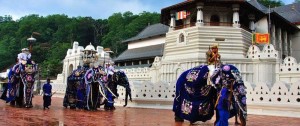
The crowd is impatiently waiting to get a glimpse of the tusker carrying the relics casket. It’s a wonderful sight to see the tusker dressed in a decorated costume and brilliantly illuminated bearing the ransivige in which the Perahera Karandawa rests on a velvet cushion, with garlands of jasmine flowers hanging dangling above it and strings of lights flickering all the time, tread over the pavada in assured steps under the canopy held over the ransivie by 16 able bodied men with poles and strings. As the karanduwa passes by, the crowd, stand up and with their hands clasped together chanting sadhu, sadhu, sadhu thereby paying their homage to the Sacred Tooth Relic.
The focus of the crowd then moves towards the Diyawadana Nilame who, attired in his traditional Kandyan constume, slowly walks by under a large e embroidered umbrella held by a Vidane of the Maligawa and flanked by two troupes of Ves dancers whose performance is a lovely sight to see.
Over 75 caparisoned elephants, 1000s of dancers and drummers, hundreds of flag bearers and torchbearers take part in each of the Peraheras. The Maligawa Perahera is followed by the Devala Peraheras in the order of Natha, Vishnu, Kataragama and Pattini under the direction of the respective Basnayake Nilames, who in their traditional Kandy an costumes, take part in the Esala Perahera Kandy.
After the day of the Esala Perahera, it is customary for the Diyawadana Nilame and the Basnayake Nilames of the four devalas to report to Her Excellency the’ President that the Esala Perahera in Kandy was satisfactorily conducted.
As the Esala Perahera draws to an end, the onlooker is apt to conclude that it is nothing but sheer ingenuity of the Buddhists from ancient times to have organized the country’s talents in arts and g crafts including drumming and dancing into a cultural pageant of such magnitude and offer it to ‘” the Sacred Tooth Relic of Lord Buddha as a form of veneration.
The Road Show of Sri Lanka Tourism ended with success on 7 June, 2016. Sri Lanka Tourism and the representatives of Sri Lanka travel agencies visited Korea, and introduced tourist attractions and vision of Sri Lanka to the travel industry and media of Korea. Also B2B consulting was provided in the event.

The Road Show of Sri Lanka Tourism
The ambassador of the Embassy of Sri Lanka, Manisha Gunasekera, had an interview with Korean media. “Currently not many Korean tourists visit Sri Lanka since direct flights from Korea to Sri Lanka have recently been created. However, Sri Lanka has become one of popular countries to travel in China and Japan. We are focusing on promotion of tourism in Korea through participating in Korea World Travel Fair and Busan International Travel Fair, and in the planning stage to promote cooperatively with Korean Air which flies to Sri Lanka.”

Regarding the reason of increased percentage of tourists the ambassador mentioned “Now large-sized hotels are being constructed in Sri Lanka, so the accommodation will be increased by 60% throughout the country. Also new airline routes to Europe will be added. Based on ample tourism infrastructure we will attract more tourists.
In closing, the ambassador said “Buddhism culture, Ceylon tea, and coconut oil are great things of Sri Lanka, as well; cinnamon, water sports, and whale watching are world’s top level. Sri Lanka has many important factors as a popular tourist destination such as beautiful nature, beach, long history and culture, wild animals and UNESCO World Heritage. And the best thing is Sri Lankan people’s kind attitude to welcome tourists.” She emphasized that various aspects of Sri Lankan culture and tourism including cultural properties, food festival, traditional dance performance to celebrate the 40th Korea-Sri Lanka relations will be introduced.